
I now found myself the happy owner of Osho’s Only One Sky.
I was so captivated by its contents that I devoured it.
In this book, the Indian mystic lays out his vision of the world: humanity creates far too many divisions—religions, nations, ideologies. Genuine transformation, he argues, can only arise through an inner revolution within each individual, not through external political systems that have exhausted themselves.
Reading these words was an immensely powerful experience for me.
I felt as though he had given language to truths I had long sensed deep within myself but had never been able to express.
On the back cover of the book were the contact details of Osho’s ashram—then still known as Bhagwan’s ashram—located in Poona (now Pune), in the state of Maharashtra, India. The ashram welcomed Western seekers.
Back in Montréal, I wrote to them.
Their reply came quickly, warmly inviting me to visit.
Once again, the wheel of destiny began to turn.
I decided to book a ticket to Poona for my next vacation
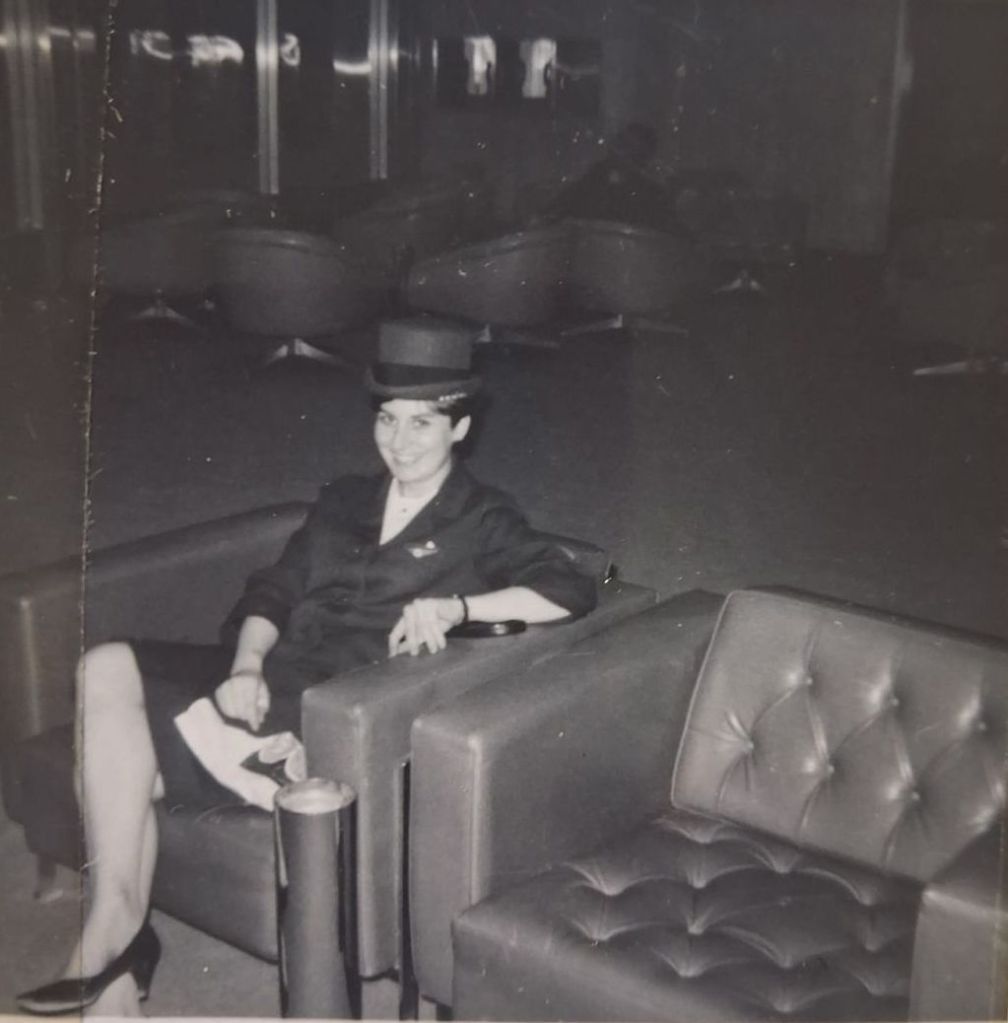
Ironically, India had been the very last place I ever imagined wanting to visit.
I associated it with overwhelming poverty and food far too spicy for my taste.
Yet, to my great surprise, the moment I stepped off the plane in Mumbai, I was overcome by a strange and unmistakable feeling:
I had come home.
Simply placing my feet on Indian soil immediately drew me into a meditative state.
From that day forward, every time I returned to India, it felt like returning to a beloved companion.
And every time I left, it was like enduring the pain of a broken heart.
Mother India—Mata India—became my true homeland of the heart.
If anything, I feel this even more strongly today.
From Mumbai, I boarded a domestic flight to Poona, followed by a taxi ride to the ashram in the leafy, cosmopolitan neighborhood of Koregaon Park.
The ashram occupied three parallel streets lined with elegant homes and former palaces built by maharajas who had once come there to spend the monsoon season.
Poona had long been a retreat for Indian nobility, famous for its horse races, and later became a favored destination for members of the British Raj.
The surroundings were remarkable.
It was India, yet at the same time it felt surprisingly modern.
Gardeners cared meticulously for the grounds, security staff watched over the entrances, and everything was impeccably clean.
The gates were monitored day and night, and although beggars were a common sight elsewhere in the city, I never saw a single one inside or around the ashram.
oshonews.com
The immense culture shock of arriving in India was softened by all these details.
From the very beginning, Poona Ashram had been designed with Western visitors in mind.
It had Western-style bathrooms and comforts that made the transition far easier for newcomers.
The concept clearly worked.
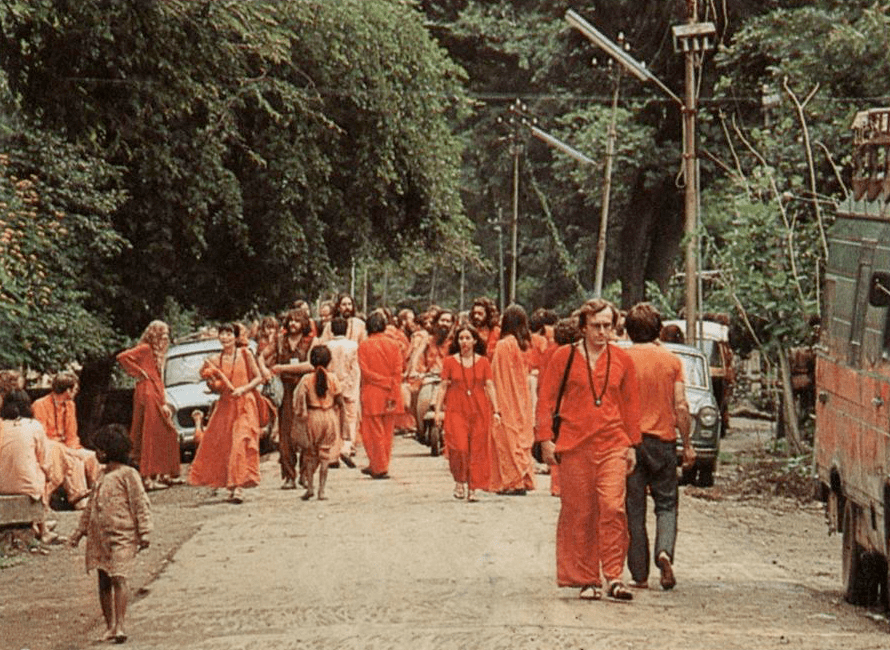
Most of the resident disciples were young Europeans and Americans.
Many wore long hair and flowing red or orange robes—the colors chosen by Osho to symbolize the rising sun and the birth of a new humanity.
They were also the traditional colors of sannyas, representing the renunciation of one’s former life.
At thirty-six years old—it was now 1978—I felt almost old among them.
Dressed in my rather short green Western dress, I felt slightly out of place, especially in a country where modesty was still the norm.
I admired these young people immensely.
They had left behind so much of their previous lives and seemed to live without attachment.
Compared with them, I realized how much inner work still lay ahead of me before I could free myself from my own attachments.
Every morning, our day began at six o’clock with Dynamic Meditation.
This five-stage meditation had been created by Osho specifically for modern men and women, helping them release accumulated physical and emotional tension.
It was largely through this practice that Osho had first become well known.
Before founding the ashram, he had introduced Dynamic Meditation to wealthy families in Bombay, where he was often invited to spend long evenings giving philosophical talks.
I still remember the powerful effects of the hyperventilation on my body.
And I vividly remember the joyful band of seekers we became as we jumped up and down with our arms raised, shouting together:
« Hoo! Hoo! Hoo! »
There was something wonderfully liberating about it.
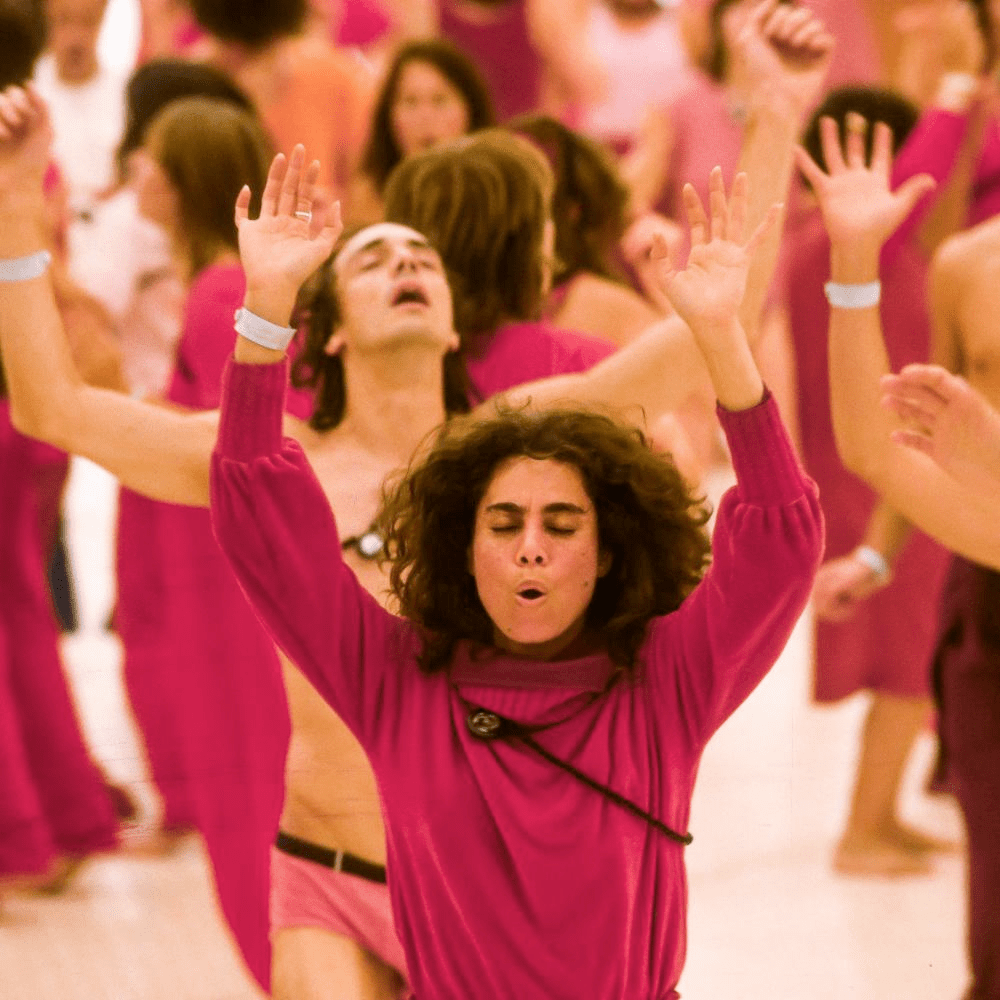
Photo by Rob Crandall
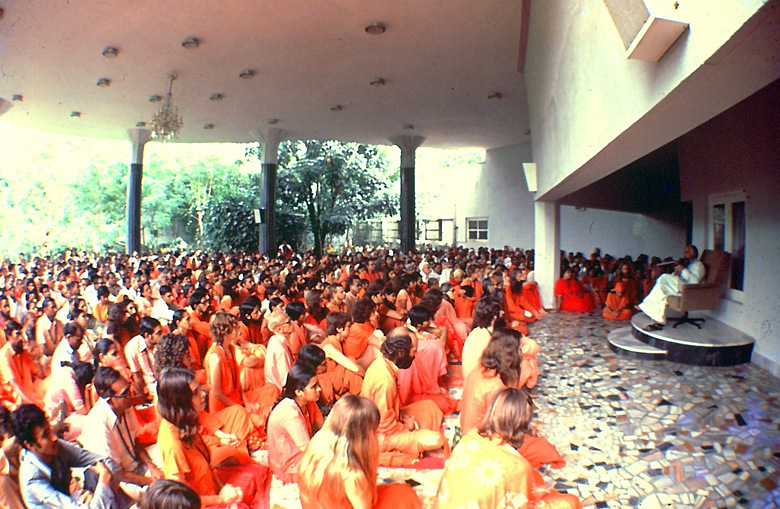
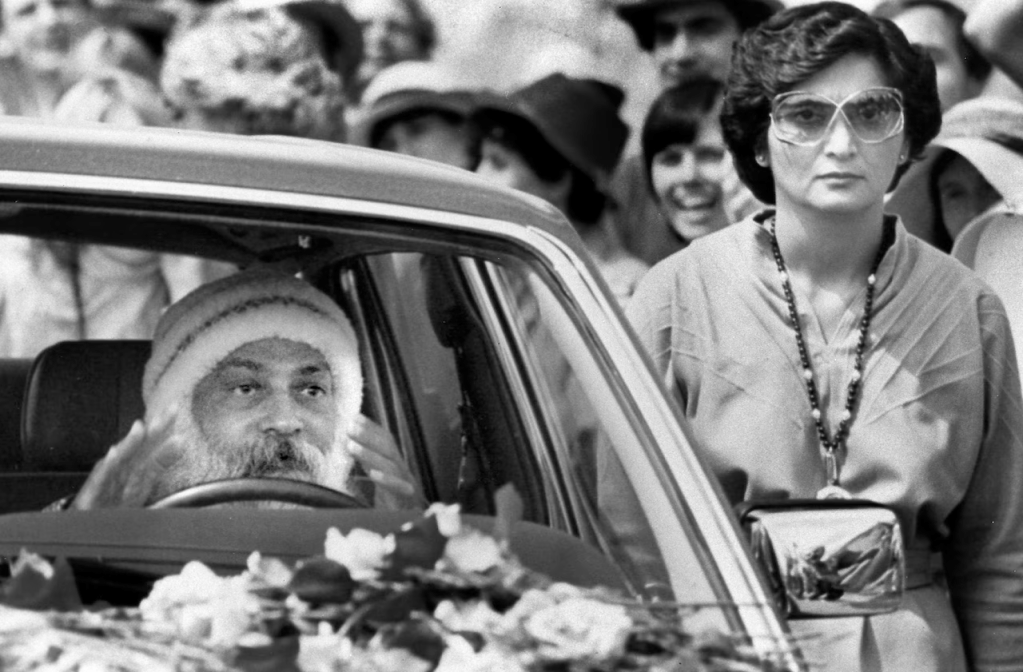
At eight o’clock each morning, we would line up outside Buddha Hall, where Osho delivered his discourses, often alternating them with question-and-answer sessions.
The queue could sometimes be surprisingly long.
Because Osho was extremely sensitive to smells, everyone entering the hall underwent a daily « olfactory inspection. » Looking back, it seems almost amusing, but at the time we accepted it as perfectly natural.
On an ordinary day, between one hundred and two hundred people attended his talks. During festivals and special celebrations, the audience could grow to nearly a thousand.
Evenings were often devoted to Sannyas initiations.
During this ceremony, a disciple formally became a sannyasin—a seeker of truth who consciously renounced the patterns of his or her former life in order to embrace a path of awakening.
It did not take me long to decide that I, too, wished to receive initiation.
During the ceremony, I was given a new name:
Prem Aikta.
In Hindi, it means « Unity in Love. »
I also received the traditional mala—a necklace of 101 wooden beads—bearing a medallion with Bhagwan’s photograph.
Putting it around my neck felt like crossing an invisible threshold.
For the third time in my life, I had been given a new spiritual name.
Each name seemed to mark the beginning of a new chapter, a new stage in my inner journey.
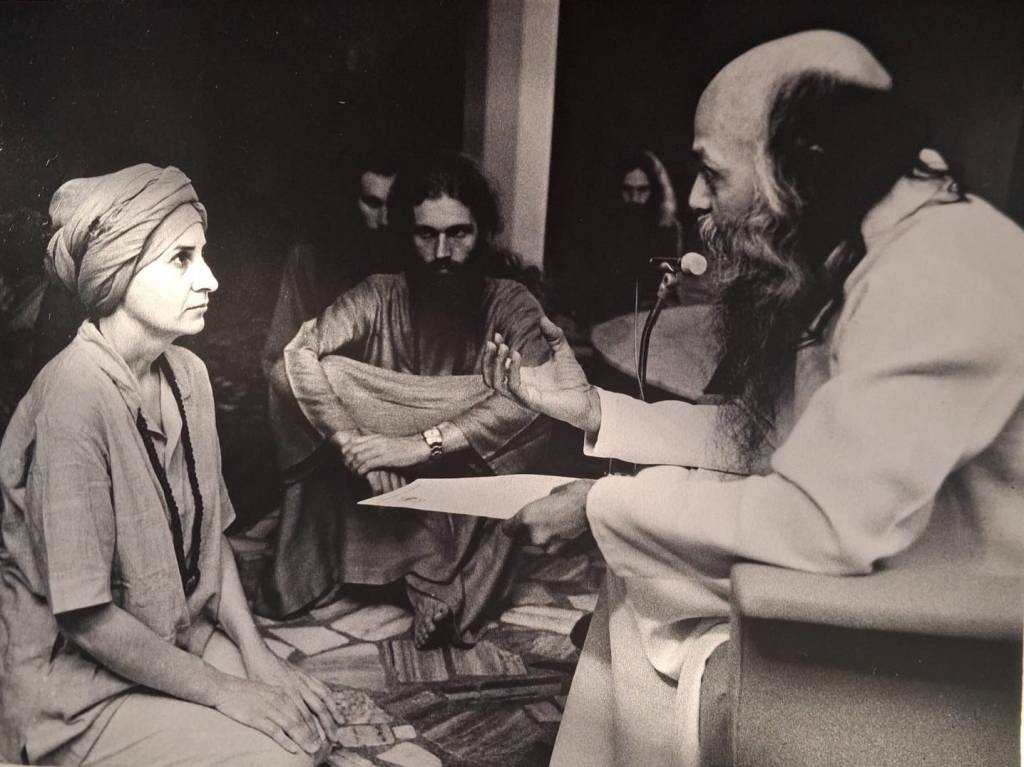
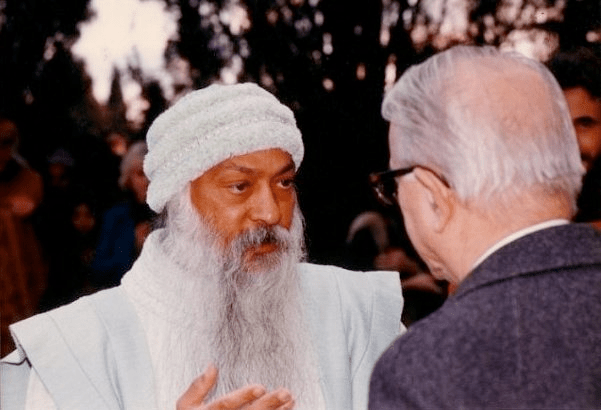
What fascinated me most about Osho in those days was not only the depth of his spiritual message, which invited us to question the very meaning of life, but also the extraordinary breadth of his knowledge.
He was astonishingly well read.
His understanding of philosophy, religion, psychology, politics, and history seemed limitless.
He was also fiercely critical of capitalism and consumer society.
Ironically, I often felt that he defended the theoretical foundations of communism more convincingly than many committed Marxists.
To me, he embodied what I would have called a kind of « spiritual communism »—a vision of human community rooted not in economics, but in consciousness.
His immense erudition nourished our minds.
His voice nourished our hearts.
Listening to him, we felt privileged to belong to the circle of a master whose intellectual brilliance seemed to surpass that of the greatest scholars of the time.
Only much later did I realize another dimension of his extraordinary presence.
Osho was highly skilled in hypnosis and had trained extensively in its techniques.
Looking back, I believe he deliberately used certain hypnotic patterns during his discourses.
The effect was unmistakable.
His voice, his rhythm, his silences, the cadence of his words…
All of it gently drew us into an altered state of awareness.
Today, I no longer believe that we retained our full critical distance while listening to him.
A few words about Osho
Originally, Osho—then known as Bhagwan Shree Rajneesh—was a professor of philosophy from the Indian state of Rajasthan. His uncompromising criticism of organized religion and of traditional Indian society eventually led him to resign from academia and establish his own spiritual movement in the late 1960s.
Believing that modern civilization suffered from a profound spiritual illness, he proposed an original vision in which spirituality was no longer opposed to the body or to sexuality, but embraced them as essential dimensions of human awakening.
His ideal was the birth of a « new man »—a fully awakened human being who was joyful, conscious, and deeply alive. His charisma, his unconventional teachings, and the freshness of his message attracted increasing numbers of Western seekers. By the late 1970s, his movement had become one of the largest and most influential new spiritual communities in the world.
When my two-week vacation came to an end, I had to leave Poona and return to my job in Montréal.
Before departing, I took a moment to thank Osho and say goodbye.
He looked at me and asked,
« When are you coming back? »
I answered that it would probably be in about a year’s time.
He smiled and immediately replied,
« Don’t wait that long. Come back within six months. »
I followed his advice.
For another six months, I continued flying for Air Canada, saving every possible dollar.
I was preparing to finance not only my journey back to India but also the substantial contribution required from anyone wishing to become a long-term resident of the ashram. It amounted to nearly eight thousand dollars.
Officially, I was preparing for a voluntary exile.
I was leaving behind my old life to seek refuge in a place where I hoped to dedicate myself entirely to spiritual practice.
But beneath that certainty, another hope still lingered.
Secretly, I kept imagining that Volker might write to me.
That he might ask me to come back. That he might finally choose me.
He never did.
His pride had been wounded, and no letter ever arrived.
From that point onward, I remained single for the rest of my life.
Not because I had rejected love, but because life was inviting me toward another kind of love altogether.
In 1979, I returned to Poona, this time ready to embrace the experience completely.
The welcome I received at the ashram felt warmer than before. I was no longer a curious visitor discovering an unfamiliar world. I felt that I belonged.
There was another visible difference as well. This time, I was dressed in red. Wearing the robes of a sannyasin, I no longer felt like an outsider. I was becoming part of the community.
I was soon assigned a position in the Press Office. Because I spoke and read German fluently, my role was to review and translate articles from the German press that mentioned Osho or the ashram—whether they were favorable or critical.
I remember one particularly striking headline published by a major German newspaper: « The Devil of Poona. »
Far from being offended, Osho thoroughly enjoyed it. He often said that all publicity was good publicity.
The article amused him more than it disturbed him.
For me, having this responsibility gave me a genuine sense of belonging. I was no longer simply receiving from the community. I was contributing to it.
sannyasnews.org – Author and date unknown
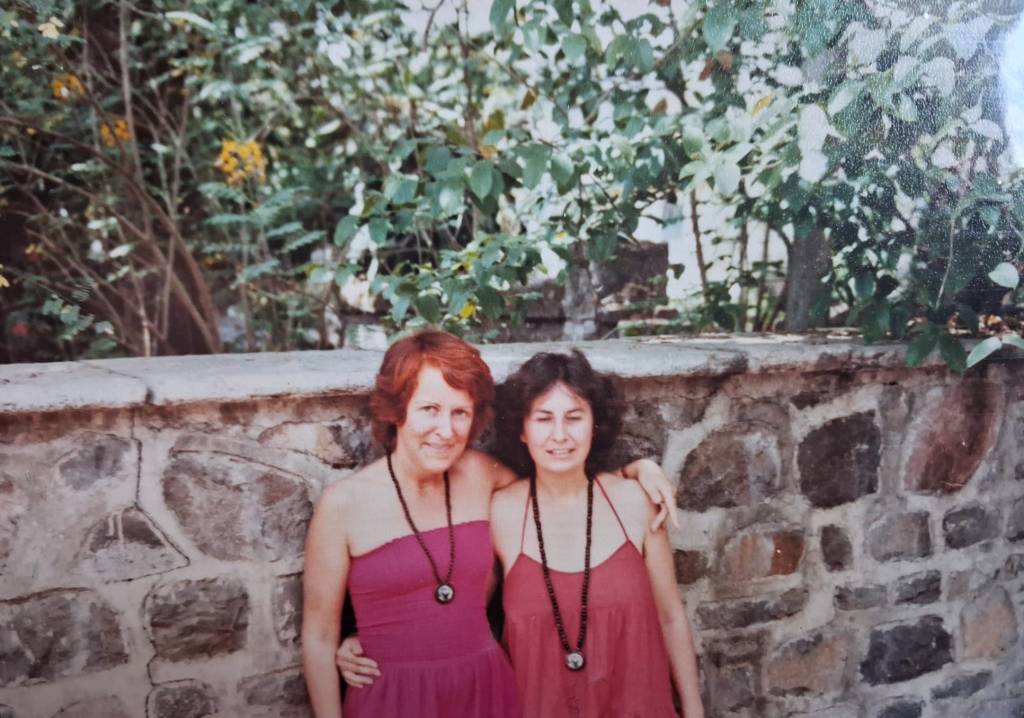
During those two years in Poona, several important realizations gradually emerged within me.
Little by little, it became clear that I had not come into this life to experience love primarily through marriage or family.
At the same time, I was slowly grieving the end of my relationship with Volker.
My soul seemed to be yearning for something deeper.
I no longer wanted to become entangled in a relationship that might once again limit the freedom of my inner journey.
This realization did not come through reasoning alone. It unfolded quietly, almost imperceptibly, until one day I simply knew.
One of the great gifts of community life is that, unlike family, it is freely chosen.
You do not inherit the people around you. You choose to walk alongside them because you share a common aspiration.
I also discovered that a community places far fewer expectations on any one individual. Within a family or a couple, we often expect one person to fulfill nearly all our emotional needs.
In a healthy community, those needs naturally find expression through many different relationships. One friend offers wisdom. Another companionship. Someone else brings joy, comfort, or inspiration.
No single person has to carry the whole weight of another’s happiness. That felt profoundly liberating to me.
Life at the ashram flowed with remarkable ease. Conflicts certainly existed—as they do anywhere—but they seemed less important than our shared commitment to awakening.
What united us was far stronger than what divided us.
Then, in 1981, everything changed. Without warning, Osho left Poona for the United States.
One morning we simply woke up… and he was gone.
No announcement had been made.
No farewell had been offered.
No explanation had been given.
For two days, no one at the ashram knew what had happened.
Finally, one of the senior administrators informed us that Bhagwan had traveled to America to undergo back surgery. In reality, that operation never took place.
He had quietly left India to begin preparations for what would become a new commune in Oregon. All the visa arrangements and travel plans had been organized in complete secrecy.
For those of us who remained behind, the experience was deeply unsettling. Almost overnight, the sense of certainty that had sustained the community began to dissolve. A quiet atmosphere of uncertainty spread through the ashram. Only a week before his departure, the warehouse containing Osho’s books had been destroyed by fire.
Personally, I have long believed that the fire was orchestrated from within the organization itself. It created the impression that Osho’s safety was under immediate threat, thereby helping justify his sudden departure from India and facilitating his move to the United States.
Whether that interpretation is correct or not, it reflected how bewildered many of us felt at the time.
I remained in Poona for several more months, hoping he would return. As the weeks passed, it became increasingly obvious that he would not.
I was heartbroken.
When I had left Montréal, I believed I was leaving forever. I had imagined spending the rest of my life in Poona. Instead, the place I had chosen as my permanent home had suddenly ceased to exist in the way I had known it.
Once again, life was asking me to let go. And once again, I had no idea where the next step would lead.
Homeless once again, I returned to Montréal.
In retrospect, the timing was almost providential, for I still had a few practical matters to settle. Volker paid me my share of a piece of land we had purchased together in the Laurentians, which he had recently sold.
That money would later enable me to make the $17,000 contribution required to become part of Osho’s future community in Oregon—the Ranch. News had begun to spread that a new commune was taking shape in the American West.
Hundreds of disciples had sold their homes, emptied their savings accounts, and pooled their resources to purchase an immense tract of land—some 260 square kilometres of sparsely populated, semi-arid countryside in Oregon.
The project was monumental.
It reflected the scale of Osho’s vision and of the hopes shared by his followers. We believed we were helping to create nothing less than a new society, one founded upon a higher level of consciousness.
I did not remain in Montréal for long.
Before the Ranch was ready to receive everyone, the community sent me to the desert south of Los Angeles. This was where many former therapists from Poona were temporarily assigned while construction continued in Oregon. I was not one of the therapists myself, but my name had already been placed on the waiting list for Rajneeshpuram.
So I waited. Like everyone else, I trusted that the right moment would come.
Finally, in 1983, I arrived at the Ranch. It had already been given its new name: Rajneeshpuram.
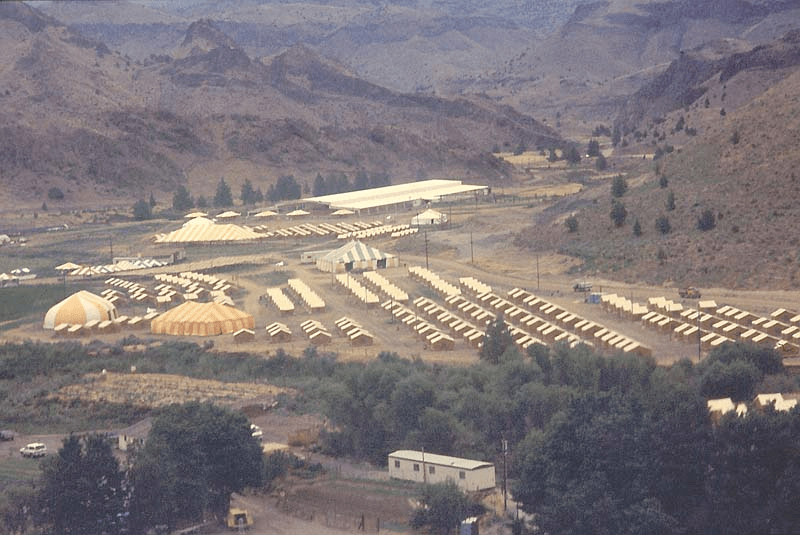
At first, there was almost nothing there. Only open land stretching toward the horizon… and rows of tents.
Those tents became our homes during the first months. Looking around, it was difficult to imagine that a thriving city could one day emerge from such an empty landscape. Yet that was exactly what we believed we were building.
© 2003 Samvado Gunnar Kossatz, Wikimedia Commons
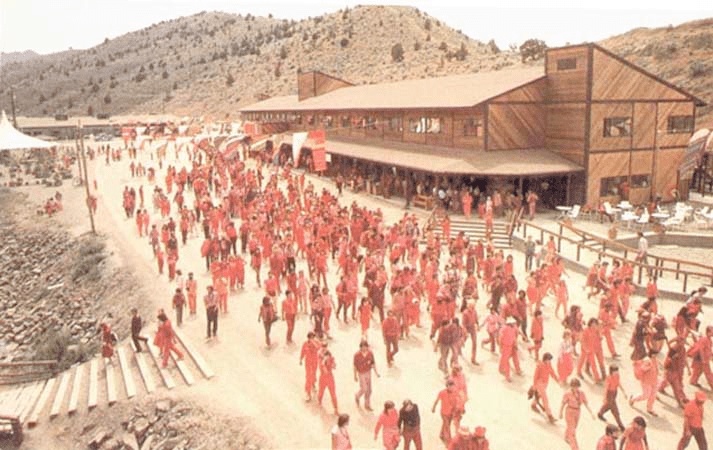
Soon afterward, the community began purchasing prefabricated buildings from the U.S. Army. Little by little, a town started to rise from the desert.
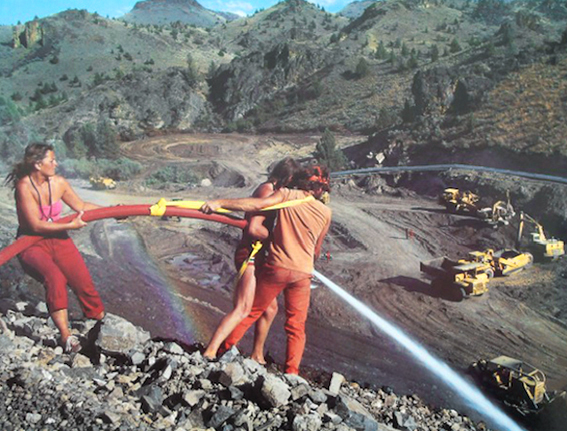
We worked between twelve and fourteen hours every day.
There was always another task waiting. Fields had to be ploughed. Vineyards planted. Roads constructed. A dam built. Reservoirs dug. Workshops, kitchens, housing, offices…
Everything had to be created from nothing. The scale of the undertaking was overwhelming. There always seemed to be another project beyond the one we had just finished.
Yet we were immensely proud to be part of it. We genuinely believed we were helping to build the future.
Under the leadership of Ma Anand Sheela and her team, the commune even succeeded in obtaining official recognition as a municipality.
This gave Rajneeshpuram far greater freedom to manage its own affairs.
Implicitly, it also reduced outside interference from local authorities.
That marked the beginning of the growing conflict between the commune and the surrounding population, as well as with various state and federal agencies.
Many books and documentaries have already told that story in great detail. I do not wish to dwell on it here. My concern is simply to share the part of the experience that I lived myself.
The Oregonian archives
For my part, I spent much of my time preparing meals for the construction crews. People affectionately called me the « Crew Mama. »
I also helped erect fences around the property. That work was physically demanding, especially on my back. After all, we were enclosing an area of nearly 80,000 hectares in an almost desert landscape.
It was exhausting. Yet I rarely questioned what I was doing.
Unlike Poona, however, something essential had changed. The atmosphere was no longer centred on meditation, therapy, or inner transformation. At Rajneeshpuram, our work had become our meditation.
Date and author unknown
Originally, we were allowed one day off each week.
That changed after a tragic accident. One of the disciples, spending his free day swimming in a nearby lake, drowned. Following his death, Sheela decided to abolish weekly days off altogether. Whether that decision was justified or not, it reflected the increasingly demanding atmosphere within the commune.
Work filled nearly every waking hour. There was very little space left for anything else. Only a deep inner conviction could sustain such a way of life.
And yet, most of us genuinely felt privileged to be there. We believed we were pioneers. History, we thought, was unfolding before our eyes. We were building the society of tomorrow.
Date and author unknown.
What sustained me more than anything was the Sangha—the spirit of community. In Sanskrit, Sangha refers to the community of those who walk the spiritual path together.
You were never truly alone. Someone was always there to help, encourage, or simply listen.
We shared a common ideal. A common dream. A common vision of what humanity might become.
That feeling gave us tremendous strength.
Sadly, the way events unfolded would eventually reveal that this Sangha was, at least in part, an illusion.
Without realizing it, we had recreated another hierarchical society. A pyramid. At the top stood a handful of leaders.
Below them, the rest of us worked tirelessly, like ants, carrying out the tasks entrusted to us. At the time, we did not see it. Our idealism was sincere, our commitment was genuine.
Only later did I begin to understand that even communities founded upon the highest aspirations are not immune to the temptations of power.


Laisser un commentaire